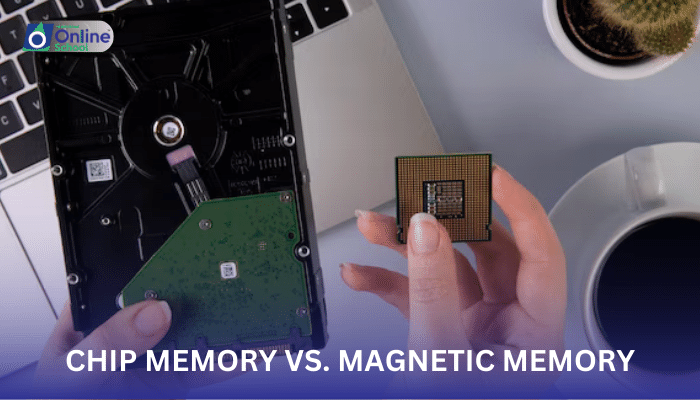
Lesson 02: Chip Memory vs. Magnetic Memory: Exploring Storage Technologies

Lesson 17/101 | Study Time: 30 Min
Lesson 02: Chip Memory vs. Magnetic Memory: Exploring Storage Technologies

Learning Outcomes


Upon successful completion of this lesson, students will be able to:


i. Define and differentiate between chip memory, also known as semiconductor memory, and magnetic memory, understanding their respective storage mechanisms.


ii. Explain the working principles of chip memory, utilizing electronic circuits to store data, and its advantages in terms of speed and access times.


iii. Grasp the concept of magnetic memory, employing magnetized particles to store data, and its strengths in terms of data persistence and cost-effectiveness.


iv. Recognize the applications of chip memory in various devices, such as computers, smartphones, and tablets, due to its fast performance and compact size.


v. Appreciate the role of magnetic memory in large-scale storage solutions, such as hard disk drives (HDDs) and solid-state drives (SSDs), due to its high capacity and affordability.


vi. Evaluate the suitability of chip memory and magnetic memory for different storage needs, considering their respective strengths and limitations.


Introduction


In the realm of computing, the storage of information plays a pivotal role, enabling the preservation and retrieval of data that is essential for the operation of computers and the execution of various tasks. Two primary types of memory, chip memory and magnetic memory, have emerged as the dominant technologies for storing digital information. This lesson delves into the world of chip memory and magnetic memory, guiding students through their distinct characteristics, applications, and suitability for different storage needs.


i. Chip Memory: The Electronic Guardian of Data


Chip memory, also known as semiconductor memory, utilizes electronic circuits to store data. Within these circuits, tiny transistors act as switches, capable of representing binary digits (0s and 1s) by switching between conducting and non-conducting states. This mechanism allows for fast and efficient data storage and retrieval.


Advantages of Chip Memory:


Speed: Chip memory offers superior speed, enabling rapid data access and retrieval.


Access Times: Chip memory exhibits low access times, minimizing delays in accessing stored data.


Compact Size: Chip memory components are compact and lightweight, making them suitable for portable devices.


Applications of Chip Memory:


Computer Memory (RAM): Chip memory serves as the primary memory in computers, enabling fast access to data during operation.


Mobile Devices: Chip memory is prevalent in smartphones, tablets, and other mobile devices due to its compact size and low power consumption.


Embedded Systems: Chip memory is integrated into various embedded systems, such as microcontrollers and sensors, providing real-time data storage and processing capabilities.


ii. Magnetic Memory: The Enduring Keeper of Information


Magnetic memory utilizes magnetized particles to store data. These particles, typically embedded in a thin film or disk, can be aligned in two distinct states, representing binary digits (0s and 1s) based on their magnetic orientation. Magnetic memory offers persistent data storage, retaining information even when power is lost.


Advantages of Magnetic Memory:


Data Persistence: Magnetic memory retains data even without power, ensuring data preservation over time.


Cost-Effectiveness: Magnetic memory offers high storage capacity at relatively low cost per gigabyte.


Durability: Magnetic memory components are generally durable and resistant to physical damage.


Applications of Magnetic Memory:


Hard Disk Drives (HDDs): HDDs employ magnetic platters to store large amounts of data, making them a cost-effective solution for long-term data storage.


Solid-State Drives (SSDs): SSDs utilize flash memory chips based on magnetic technology, offering faster performance and lower power consumption compared to traditional HDDs.


Backup and Archival Storage: Magnetic media, such as tapes and magnetic disks, are widely used for data backup and archival purposes due to their long-term data retention capabilities.


Chip memory and magnetic memory represent two distinct yet complementary approaches to data storage. Chip memory excels in speed and access times, making it ideal for applications requiring rapid data manipulation. Magnetic memory, on the other hand, shines in data persistence and cost-effectiveness, catering to long-term storage needs. Understanding the characteristics and applications of these memory technologies empowers individuals to make informed decisions when selecting storage solutions for various computing needs. As technology continues to evolve, advancements in chip memory and magnetic memory will undoubtedly lead to even more efficient, reliable, and capacity-rich storage solutions, shaping the future of data preservation and access in the digital realm.


Saboor Ali

Saboor Ali

Product Designer

Class Sessions

1- Lesson 01: Identifying Computing Devices 2- Lesson 02: Defining Computers and Their Operations 3- Lesson 03: Classifying Computers: Microcomputers, Mainframes, Supercomputers, and Mobile Computing 4- Lesson 04: Distinguishing Hardware and Software: Understanding Their Roles 5- Lesson 05: Exploring the World of Software: System Software and Application Software 6- Lesson 06: Unveiling the Types of System Software: Operating Systems, Device Drivers, Utility Software, and Language Processors 7- Lesson 07: Exploring the Realm of Application Software: Productivity Software, Business Software, Entertainment Software, and Education Software 8- Lesson 08: From Data to Information: Understanding Data Processing and Its Importance 9- Lesson 09: Navigating the Software Landscape: Licensed Software, Open Source Software, Shareware, and Freeware 10- Lesson 10: Firmware: The Invisible Force Behind Devices 11- Lesson 11: Demystifying Computer Hardware: Input, Processing, and Output 12- Lesson 12: The Gateways to Interaction: Exploring Input Devices 13- Lesson 13: Unveiling the World of Scanners: Digitizing Information with Handheld, Flatbed, and Optical Scanners 14- Lesson 14: Displaying Information with Monitors: CRTs, LCDs, and Beyond 15- Lesson 15: From Digital to Print: Exploring Printers and Plotters 16- Lesson 01: Unveiling the Building Blocks of Memory: Bits, Bytes, and Memory Words 17- Lesson 02: Chip Memory vs. Magnetic Memory: Exploring Storage Technologies 18- Lesson 03: Volatile Memory vs. Non-volatile Memory: Understanding Data Persistence 19- Lesson 04: The Brain's Fast Track: Internal Processor Memory – Cache and Registers 20- Lesson 05: RAM: The Dynamic Duo of Memory – Static RAM and Dynamic RAM 21- Lesson 06: Understanding Computer Memory Types 22- Lesson 07: Exploring Secondary Storage Devices 23- Lesson 08: Sequential Access vs. Direct Access 24- Lesson 09: Magnetic and Optical Memory Technologies 25- Lesson 10: Exploring Chip Memories - Flash Memory & Memory Cards 26- Lesson 01: Understanding CPU Components 27- Lesson 02: Exploring General Purpose Registers 28- Lesson 03: Understanding Special Purpose Registers 29- Lesson 04: System Bus and Its Types 30- Lesson 05: Defining Instructions and Types 31- Lesson 06: Explaining Instruction Format 32- Lesson 07: Describing the Instruction Cycle 33- Lesson 08: Understanding CISC and RISC Architectures 34- Lesson 09: Differentiating Processors Based on Technical Specifications 35- Lesson 10: Differentiating Processors Based on Architecture 36- Lesson 01: Differentiating CPU and System Unit 37- Lesson 02: Identifying Computer Casing and Types 38- Lesson 04: Describing Different Ports 39- Lesson 05: Identifying Expansion Cards - Part 1 40- Lesson 06: Identifying Expansion Cards - Part 2 41- Lesson 01: Understanding Basic Network Components 42- Lesson 02: Exploring Modes of Communication 43- Lesson 03: Understanding Communication Media 44- Lesson 04: Introducing Communication Devices 45- Lesson 05: Explaining Network Architecture 46- Lesson 06: Understanding Network Types 47- Lesson 07: Exploring Network Topologies 48- Lesson 08: Understanding Communication Standards 49- Lesson 09: Introducing OSI Model and Layered Concept 50- Lesson 10: Examples of Protocols and Devices in OSI Layers 51- Lesson 11: Exploring TCP/IP Protocol for Internet Communication 52- Lesson 12: Comparing TCP/IP with OSI Model 53- Lesson 13: Distinguishing Circuit Switching and Packet Switching 54- Lesson 14: Understanding IP Addressing Scheme 55- Lesson 01: Introduction to Wireless Networks 56- Lesson 02: Understanding Advantages and Disadvantages of Wireless Networks 57- Lesson 03: Defining Key Terms in Wireless Communication 58- Lesson 04: Short Distance vs. Long Distance Wireless Communications 59- Lesson 05: Exploring Short Distance Wireless Technologies 60- Lesson 06: Understanding Long Distance Wireless Communications 61- Lesson 07: Requirements of Mobile Communication 62- Lesson 08: Features and Limitations of Mobile Communication Systems 63- Lesson 09: Explaining Communication Architecture for Mobile Devices 64- Lesson 01: Understanding Data and Information 65- Lesson 02: Exploring File Management Systems 66- Lesson 03: Defining Database 67- Lesson 04: Explaining Database Management Systems (DBMS) 68- Lesson 05: Advantages of DBMS over File Management Systems 69- Lesson 06: Role of a Database Administrator (DBA) 70- Lesson 07: Exploring Database Models 71- Lesson 08: Database Languages for Relational Databases 72- Lesson 09: Terms in Relational Databases 73- Lesson 10: Steps for Designing a Database 74- Lesson 11: Visualizing Database Elements 75- Lesson 12: Cardinalities and Modalities in Databases 76- Lesson 13: Drawing Entity-Relationship (ER) Diagrams 77- Lesson 14: Normalization of Relations 78- Lesson 01: Introduction to Relational Database Management Systems (RDBMS) 79- Lesson 02: Selecting a Database Management System (DBMS) 80- Lesson 03: Creating and Saving a Database 81- Lesson 04: Exploring the Database Environment 82- Lesson 05: Managing Tables in Different Ways 83- Lesson 06: Understanding Data Types 84- Lesson 07: Creating and Editing Relationships 85- Lesson 08: Key Constraints for Data Integrity 86- Lesson 09: Creating and Editing Table Relationships 87- Lesson 10: Record Navigation in Tables 88- Lesson 11: Record Management in Tables 89- Lesson 12: Creating and Editing Forms 90- Lesson 13: Exploring Form Views 91- Lesson 14: Record Navigation in Forms 92- Lesson 15: Record Management in Forms 93- Lesson 16: Utilizing Form Controls 94- Lesson 17: Creating, Saving, and Editing Queries 95- Lesson 18: Implementing Different Types of Queries 96- Lesson 19: Generating Reports Using Report Wizard 97- Lesson 20: Utilizing Various Report Layouts/Styles 98- Lesson 21: Setting Sort Order for Reports 99- Lesson 22: Customizing Reports Using Queries and Expressions 100- Lesson 23: Saving, Viewing, and Printing Reports 101- Lesson 16: Soft Copy vs. Hard Copy: Distinguishing between Digital and Physical Representations of Data